

The blinking cursor is the biggest time sink in your marketing department. In a production-driven world where the daily grind has been replaced by the hourly upload, the pressure to produce high-volume, high-quality content has moved past the point of human scale.
Thank god we’ve got AI article writers. They sit somewhere between the jack-of-all-trades Gen AI, which can write a sonnet or Python code depending on what you need on any given day, and an experienced, skilled human content writer who, as mentioned, can no longer simultaneously meet the market’s quality demands and pace.
This guide explores whether article writers are the ultimate creative power-up or a looming threat to the human in human-centric marketing.
Subscribe to the ai marketer
Weekly updates on all things ai in marketing.

A Brief Introduction to AI Article Writers
An AI article writer is a generative AI tool that uses advanced natural language processing (NLP) and machine learning (ML) to automate text generation, including articles and other content formats.
AI article writers and general large language models (LLMs) overlap in their core engines, but they have different utilities. Classic Gen AI platforms are platforms used for everything from chatting to coding, whereas AI article writers are purpose-built to create publishable content. In doing so, they address the most persistent challenges in marketing: time constraints, drafting and markups.
These content automation tools combine content generation with specialized SEO and branding functionality and streamlined workflows, so they’re more of a content factory than a conversationalist. That means they offer the highest value to businesses creating content, including articles, social media posts, white papers, landing pages, short-form video and more, rather than individuals seeking intelligent responses to queries.
Let’s Zoom Out for a Sec… What Does This Mean for Actual Writers?
If you’re reading this, chances are you’re a human (though that’s certainly not always the case nowadays). You’ve probably figured out that AI writers will directly impact your job, for better or worse, if you’re a human working in content marketing.
Like any other tool (think computers, cars, social media or electricity generators), AI writers will impact entire digital ecosystems, including those who produce and consume content, as well as the platforms that determine how content gets consumed (social media, search engines, email, etc).
If we consider the concept broadly, we can distill some truths:
- More people are more easily producing more content. This causes a natural dip in average output quality.
- Human writers are increasingly not creating that content from scratch.
- ML and Gen AI enable us to produce greater volumes of content and analyze deeper trends, which we can use to personalize at scale.
- Consumers now expect better quality content and greater personalization. Marketers must maintain quality and velocity while meeting advanced personalization expectations.
Moreover, few events of global proportions have occurred to spur policymakers to implement legally enforceable AI-generated content guidelines that would provide GRC-grounded direction for AI use and, ideally, security in our AI content.
5. Someone, someday, will be that example.
Here’s what that means for a human writer:
- Mass-produced, commoditized content means the market now requires a premium perspective — and premium information. The one-and-done approach is not an effective strategy in modern content production.
- Many actual writers are moving into editing roles, polishing and refining AI-generated content to achieve human-quality results in less time. Gigs for those who don’t already have the editorial skills (e.g., entry-level writing positions) might become extinct.
- Hyperpersonalization is taking an even stronger hold. Audiences expect it, and they’re quick to reward those who deliver. Among marketers who personalize digital experiences, 44% report a significant increase in sales (and another 44% report a moderate increase).
- There’s this weird space where there are no “rules” for using AI at scale in content, meaning there’s a massive potential for liability following destructive AI hallucination events… Yet few businesses actually have AI policies to avoid it.
- SEO is no longer just about keywords, but LLM optimization, ensuring AI platforms (including Gemini in Google’s AI overview) cite your resources as a primary source.
The silver lining is that, while all of these represent the result of AI writing tools, AI writing tools are also the way through: They help get the busywork done, so actual writers can check, refine and keep content up with the market’s expectations.
AI Writer Tools to Test
In 2025, 85% of marketers intended to invest in their digital ecosystem to streamline the creation and distribution of personalized content. So if you’re looking to add new Gen AI tools to your tech stack, the first question to ask is where you need the most support, between:
- Publishable SEO and marketing content.
- General writing assistance.
- Editorial precision.
There are article generators for all three, including:
contentmarketing.ai
As you might expect, Brafton’s proprietary platform, contentmarketing.ai, is a Gen AI engine geared toward publishable, SEO-optimized marketing content. It features an intuitive interface that guides users through processes like:
- Ideation, including topics, content and article headlines.
- Writing, including case studies, landing pages and white papers.
- Blogs, including ‘How-Tos,’ thought leadership and explainers.
- Optimization, including E-E-A-T, reputable sources and SEO.
- Social posts, including single-asset campaigns, individual platforms and multi-platform.
- Imagery, including illustrations and from-copy.
- Email, including nurture sequences, newsletters and promotional.
- Research, including online sources and subject-matter expert interviews.
Users can select a function, then collaborate with an AI chatbot to refine article objectives, research, optimization and special requests.
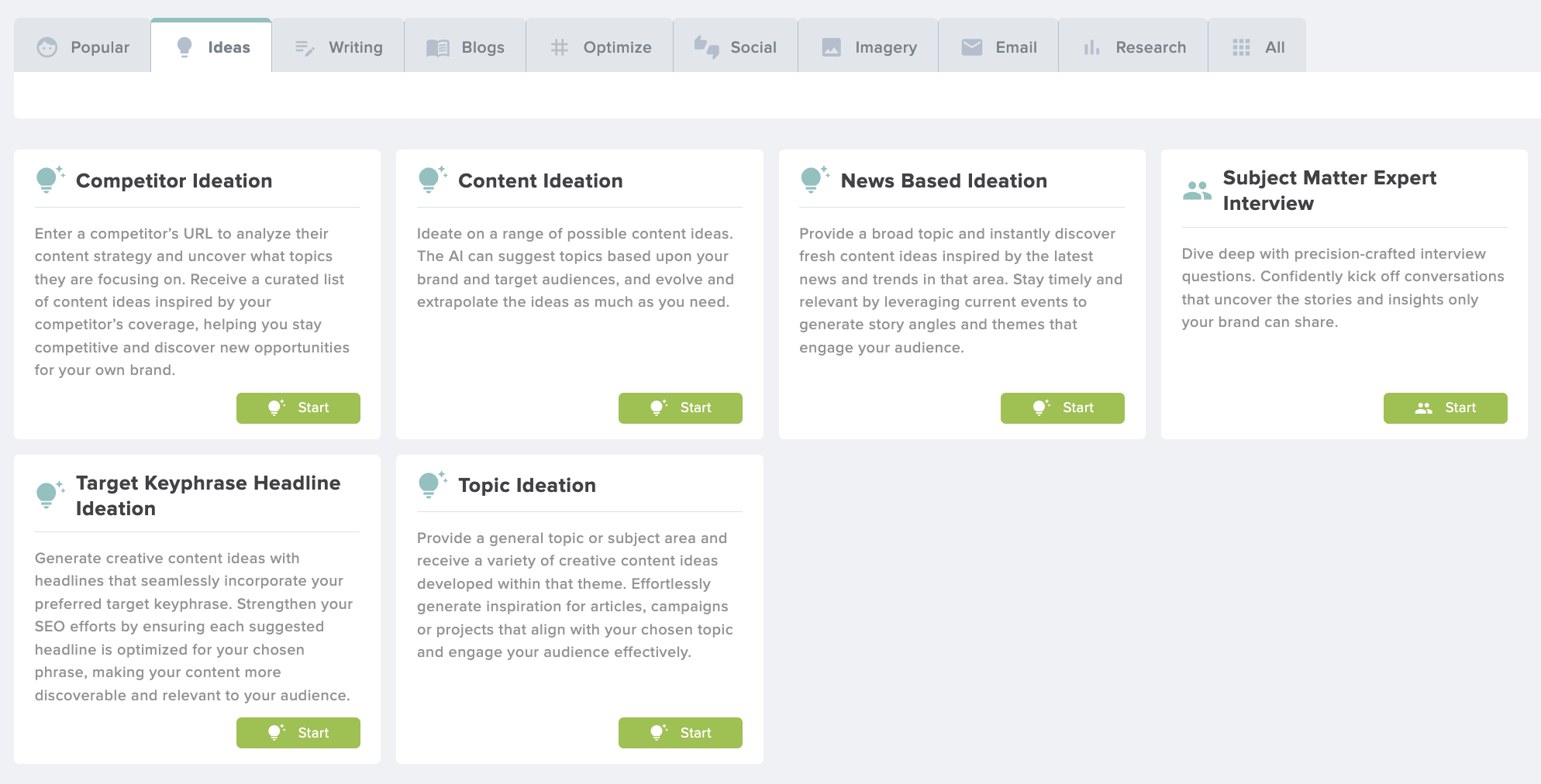
While the tool provides breadth and depth of marketing-focused content, it’s always recommended to use a hybrid workflow with human checks and refining once the content is produced. contentmarketing.ai is available on a paid subscription.
Writesonic
Writesonic is an article generator designed to increase leads and sales. It includes templates that help marketing teams create long-form content, summarize articles and rework drafts. There’s also a second set of templates for landing pages, product descriptions or social campaigns, for instance. There’s also a credit-based system to produce higher-quality articles, where needed.
Users follow a series of basic prompts to select specifications, including headlines, keywords, references and tone of voice. Once the article is ready, there is a separate tool to optimize the content for SEO. This tool is a free AI article writer to get you started and is best suited for marketing creators producing generic copy.
Jasper
Formerly known as Jarvis, Jasper’s come a long way since its rebrand in 2022. With a single click, marketers can generate copy across a range of content formats, including articles, eBooks, social campaigns, video scripts, ad copy and more. And while the platform offers breadth, it lacks depth in perspective-driven, highly creative or complex technical subject matter.
Jasper relies on generating content based on the data it’s been trained on, meaning inaccuracies can arise and meaningful human input is still required. Because it’s not an SEO-first content generator, it’s best suited to automating general marketing content tasks, such as email, product listings and social posts.
Grammarly
Grammarly has long led the market of AI editorial assistance, but throughout 2025, it rolled out major upgrades, including an AI article generator. The platform is free, with paid subscriptions offering more advanced copyediting suggestions and features.
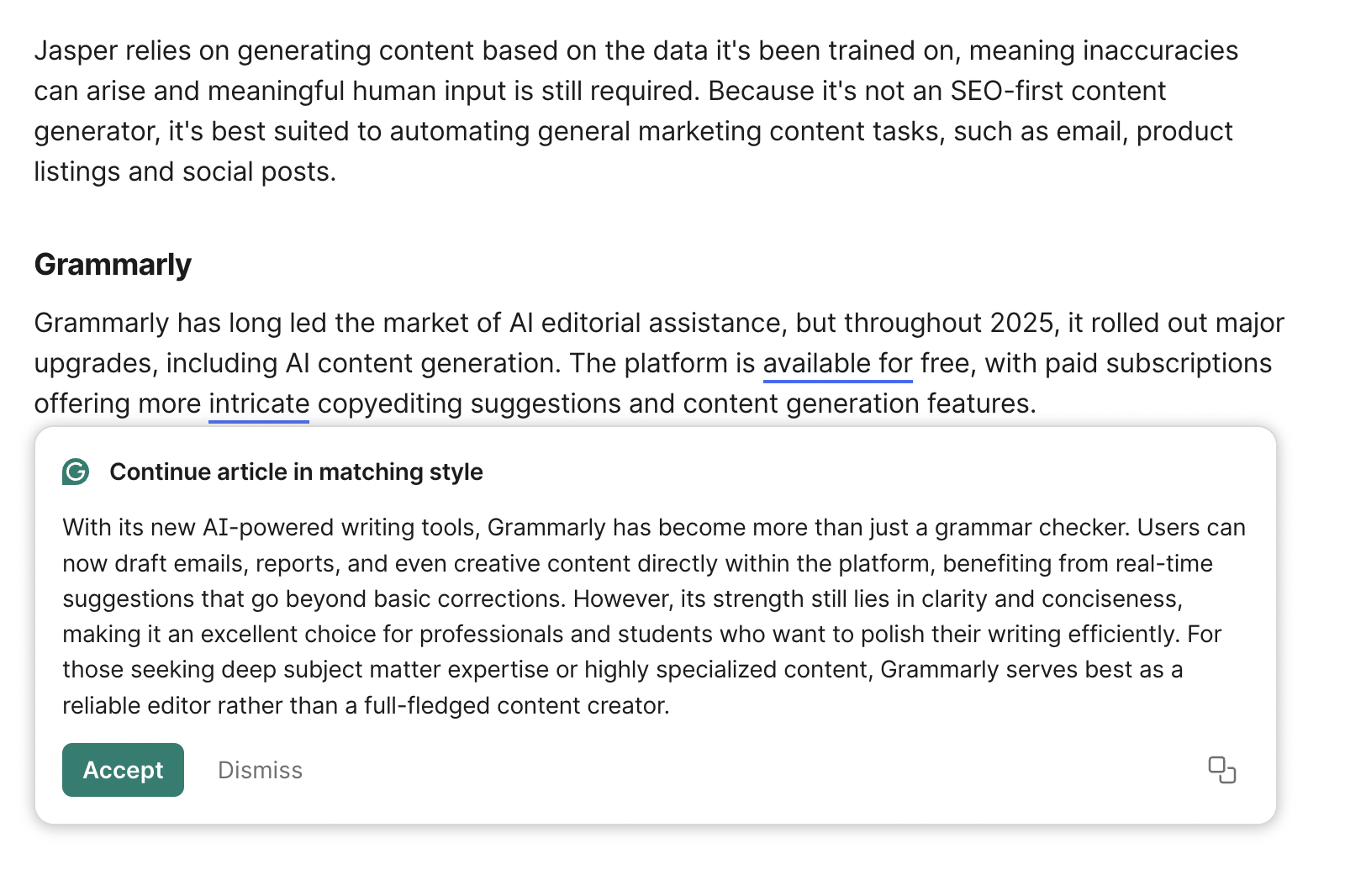
Grammarly offers a range of delivery styles and includes AI detectors, as well as fact and plagiarism checkers that still require human review. This tool is ideal for professional communicators, academic writing and marketers who want to add AI-generated content with thorough copyediting to their tech stack.
Best Practices for Using an AI Writer
All platforms write slightly differently, but a few best practices apply across the board, regardless of whether you’re using any of the above.
- Go hybrid: AI article writing is an epic timesaver and allows you to focus on what’s actually important. But the market demands better content than even the pre-AI days, and the bar is constantly rising. Always pair an AI text generator with a human writer.
- Know your weaknesses: The point of automation is to simplify content creation, so know where you need the most help and opt for a tool that makes up the difference.
- Develop an AI policy and learn from what’s going on in the industry: From a GRC perspective, things haven’t become complicated… Yet. Start developing AI best practices and fair-use policies now, and develop them as your AI usage and the industry evolve.
- Experiment: Hold open discussions with your team and develop a comprehensive writing process. Our editorial team is continually discussing challenges and new hacks in contentmarketing.ai.
- Don’t quit your day job: In many ways, the role of a writer is now more important than ever, specifically because the market rewards the human element (e.g., Google’s E-E-A-T). But developing those skills from the ground up in real-world scenarios will become more difficult as article writers take hold. Continue cultivating mature human writing skills.
Using AI in Marketing Without Losing the Figurative or Literal Plot
At the end of the day, an AI article writer is a tool. If you treat it as a shortcut to bypass strategy, you’ll likely end up with a library of commoditized, vanilla content that the market and algorithms alike will eventually ignore.
Moving forward, the strongest marketing outcomes will come from teams that provide clear direction, maintain ruthless editorial standards and hold their AI-assisted outputs to a higher level of accountability. By treating AI as an assistant rather than a qualified author, marketers can offload the busywork and reclaim the mental real estate needed for genuine innovation and impact.